


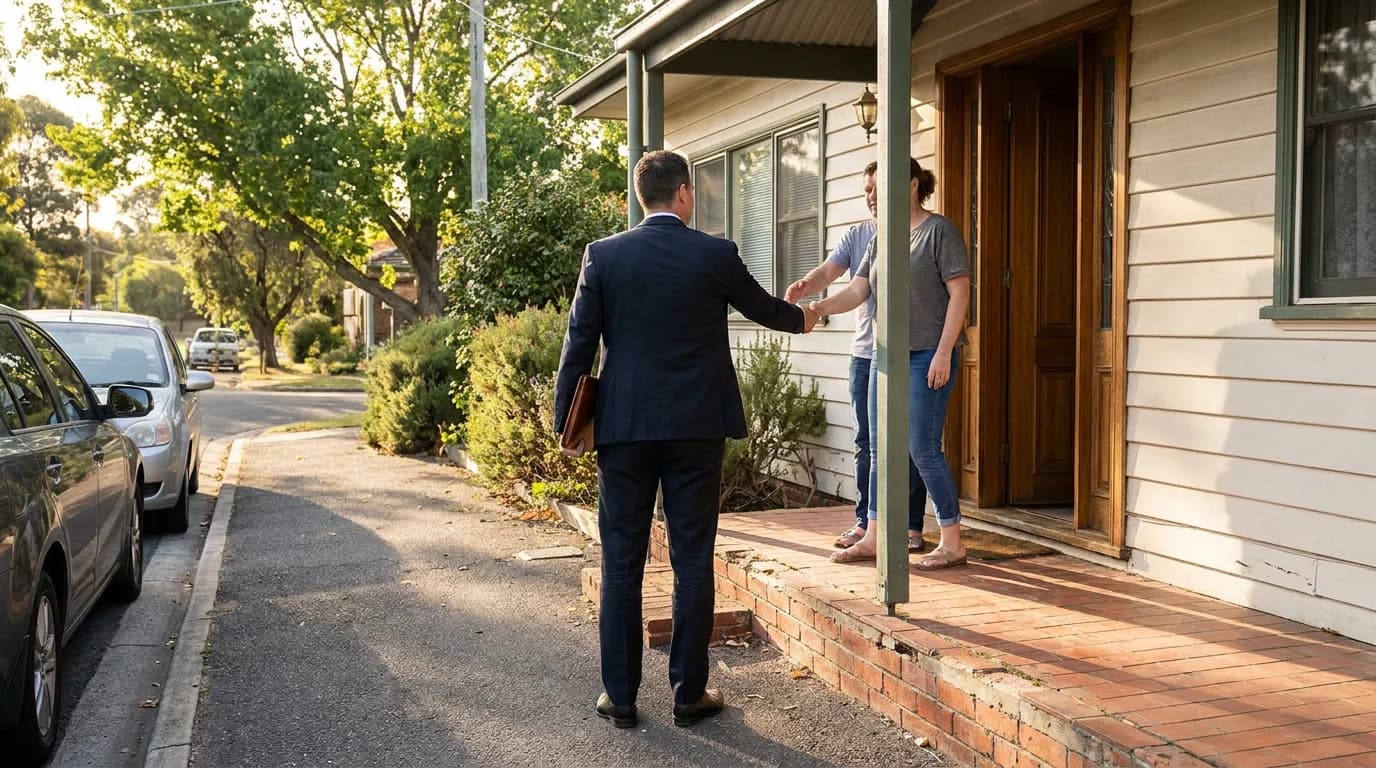
Buying the listing is when a real estate agent deliberately overquotes your home's value to win your business, then spends the campaign walking your price down to what the market will actually pay.
Most real estate agents in Perth earn a percentage of whatever your home sells for. That means they earn more when the sale price is higher. It also means they have a financial incentive to tell you what you want to hear.
The industry's term for the second part of this process is “conditioning the vendor.” An agent quotes high to win your business, you sign an exclusive agency agreement, and then the real work begins: walking your expectations down to a price the market will actually pay.
The problem is systemic: when commission is tied to sale price, the incentive to guess high is built into every appraisal. The agents who quote honestly risk losing the listing to the one who tells you what you want to hear.
ABC Four Corners covered this practice in March 2023 (“Agents of Influence”). The REIQ CEO said it plainly: “A real estate professional shouldn't be inflating the price in order to secure the listing and then subsequently trying to condition the vendor to accept a lower price.”
Overview
What this article covers
- 01Why inflated appraisals work on smart people
- 02How the commission model makes this inevitable
- 03What "conditioning the vendor" looks like in practice
- 04The difference between portal estimates, appraisals, and formal valuations
- 05How to protect yourself before you sign with anyone
Why it works on you
Two things make this effective, and neither is about being naive.
The first is anchoring. Northcraft and Neale published a study in 1987 (Organizational Behavior and Human Decision Processes) that found both professional real estate agents and amateurs anchored to a stated listing price, even when told to ignore it. The higher the stated price, the higher their valuation. Once an agent tells you $1.4M, your brain treats that as the starting point. Every reduction from there feels like a loss, even when the correct market price was always $1.15M.
The second is the endowment effect. You've spent years in this house. Every renovation dollar, every weekend of maintenance, every birthday party in the backyard has been mentally capitalised into what the property is “worth.” The agent who tells you the highest number isn't deceiving a sceptic. They're confirming what your own brain already believes.
This combination is why buying the listing works on smart people. It's designed to.
Why the commission model makes this inevitable
Traditional agents in Perth earn around 2.5% of whatever price they achieve. Follow that incentive for thirty seconds.
Quoting high costs the agent nothing. It wins the listing. Once you've signed an exclusive agreement, the agent has a locked-in seller and a guaranteed commission on whatever the property sells for. Quoting $1.4M and closing at $1.15M still earns a fee. The inflation isn't incidental to the commission model. It's a predictable output of it.
What “conditioning the vendor” looks like
Once you've signed, the appraisal has done its job. Now the agent needs to bring your expectations back to reality. This usually follows a pattern:
- Weeks 1–2: Home opens are scheduled. Buyer activity looks normal. No offers come in, or they come in well below the quoted price. The agent says “the market is still warming up.”
- Weeks 3–4: The agent suggests a price reduction. They frame it as “the market is telling us something” or “buyer feedback is consistent.” The reduction is usually 5–10%.
- Weeks 5–8: A second reduction is suggested. By now the listing has been on market long enough that buyers assume something is wrong with the property, not the price. The agent uses that stigma as leverage: “we need to meet the market.”
- Weeks 8+: The property sells at or near the price a more honest appraisal would have started at. The seller has lost weeks of market exposure and the advantage of a fresh listing.
If you recognise this pattern mid-sale, you're probably already locked in. The time to protect yourself is before you sign.
What it can cost you
Sometimes the market moves fast enough that the property sells anyway, just later than it should have. But when it does cause harm, the damage compounds.
Buyer attention is highest in the first 21 to 30 days of a listing. An overpriced listing misses that window. Buyers who looked at $1.2M in week one have bought elsewhere by week four. They don't come back when the price drops. By 60 days on market, buyer stigma sets in. Buyers assume something is wrong with the property, not the price.
The regulatory gap
Some states take this seriously. WA does not.
Victoria maximum penalty
$48,842
per breach + loss of commission (Sale of Land Act 1962, s.47AF)
WA maximum penalty
$4,000
Code of Conduct for Agents and Sales Representatives
A search of REIWA's public disciplinary register doesn't surface a named WA case for a deliberately inflated appraisal. Perth sellers are largely operating without regulatory protection on this.
No commission. No inflated quotes.
Want an honest appraisal?
KeyHive charges a fixed fee, the same regardless of what your home sells for. No reason to quote high.
What to do about it
Six things you can do before signing with anyone.
Get appraisals from two or three different agents
Not one. Two or three, from different agencies. If one agent quotes $1.3M and the other two quote $1.05–$1.1M, that spread tells you something. The outlier isn't necessarily wrong, but you should ask them to explain the gap with specific comparable sales.
Ask for three comparable sales
Within 1km, same house type, similar land size. Ask whether they sold above, at, or below their listed price. In Perth's current market, nearly everything sells at or above. If the agent's comps all sold below, the data is stale or cherry-picked.
Check the comps yourself
REIWA's sold search (reiwa.com.au/sold/) shows both the sold price and the original listed price. You can verify everything the agent tells you in ten minutes.
Get a formal valuation from a licensed valuer
A registered land valuer (licensed under WA's Land Valuers Licensing Act 1978) charges $300 to $600, flat fee, regardless of the result. They have no incentive to win your listing. Their fee is the same whether your home is worth $900K or $1.4M. Formal valuations almost always come in lower than agent appraisals. That doesn't mean the valuer is wrong. It means the valuer is conservative by design, and the gap between the two numbers tells you how much optimism is baked into the agent's figure.
Ignore portal price estimates
realestate.com.au and Domain both show automated price estimates when you search your address. These are generated by algorithms using comparable sales data. They're not appraisals. They're not valuations. They don't account for your renovations, your view, your layout, or your neighbour's extension. Treat them as a rough orientation, not a basis for pricing decisions.
Understand the difference
Not all price opinions are equal. Each one has a different source, cost, and incentive structure:
Portal estimate
- Cost
- Free
- Provider
- realestate.com.au, Domain (automated)
- Vested interest
- None, but algorithm-only
REIWA price estimate (AVM)
- Cost
- Free
- Provider
- reiwa.com.au (Cotality model)
- Vested interest
- None, but statistically blunt
Agent market appraisal
- Cost
- Free
- Provider
- Selling agent
- Vested interest
- Yes (commission-based)
Licensed property valuation
- Cost
- $300–$600
- Provider
- Registered land valuer
- Vested interest
- None (flat fee)
A free appraisal from an agent is free because they're betting they'll earn it back in commission. Verify it against recent sales before you commit.
The system is the problem
The incentive to guess high is built into the commission structure. It's a rational response to a fee model that rewards winning listings over honest pricing. Multiple appraisals, verified against recent sales, give you a real number to work from.
A fixed fee removes the incentive to inflate. When an agent earns the same regardless of what your property sells for, there's no reason to quote high and walk you down later.
Related Articles
Fixed Fee vs Commission Perth: The No Incentive Myth Debunked
Fixed fee vs commission: which is better for Perth sellers? We debunk the “no incentive” myth and reveal what actually drives a higher sale price in WA.
Exclusive Agency Agreement WA: What Your Contract Actually Says
You signed an exclusive agency agreement on your phone. Four pages, DocuSign, done. Here are the key terms to check before your sale.
Real Estate Advertising Fees Perth: $3,000–$5,500 Upfront (VPA)
Perth agents charge $3,000–$5,500 in advertising fees, paid upfront into a trust account before a single buyer sees your home. Here’s what’s marked up, what’s optional, and what to ask before you sign.
Ready to sell smarter?
One fixed fee. No percentage commission. No surprises at settlement.